(
Jan 15, 2026
)
Concrete Floors, Studio Headphones, and a Still Image That Held the Room Together
When people talk about “bridging the gap,” they often mean programs, policy, funding, the visible mechanisms. I do not disagree. I just think the invisible mechanisms matter too. Attention. Entry. Permission. A way in.
The concrete floors made the gallery loud in a way that felt honest. Every footstep had a shadow. In a small room, sound becomes part of the work.
The work, in this case, was my five-minute film, Bridging the Gap, about a quiet rebellion against displacement and the kinds of care that make staying possible.
We tried to solve it the way you solve most things now. With equipment.
The curator and I set a directional speaker and aimed it like a flashlight beam, trying to give the film a voice without letting it spill across the room. We moved it, listened, moved it again. A small choreography of problem-solving that felt less like art and more like temporary architecture.
The day before, we changed our minds.
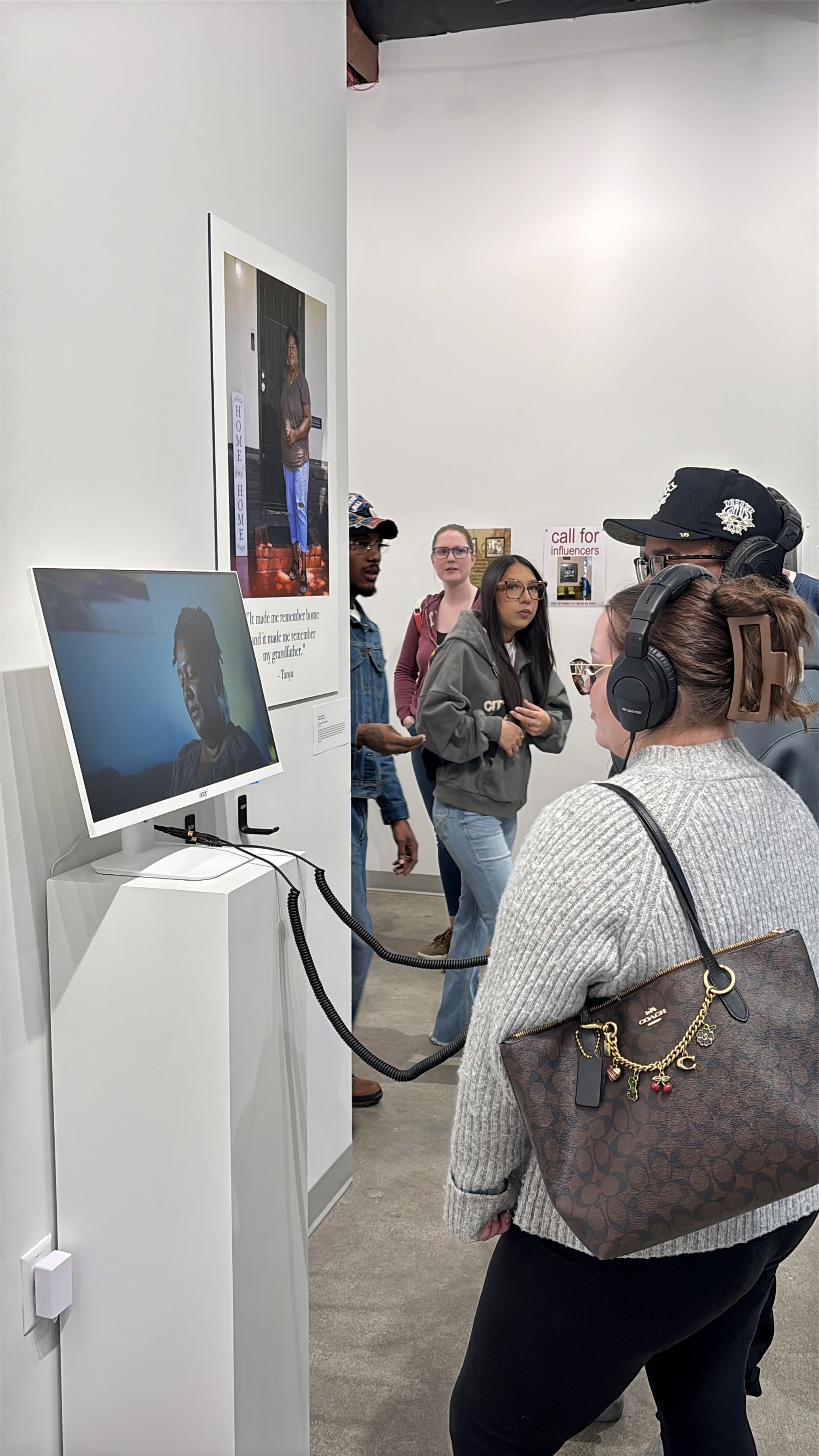
We decided it would be better to use headphones.
With the studio headphones on, the concrete-floor loudness melted away. Not silence, exactly. More like stepping into weather. You were in a shared room and, at the same time, somewhere private. The difference felt simple, almost obvious. It also felt like a lesson cities keep forgetting. People can be together without being handled.
The film was on a loop, which meant anyone could arrive at any point. Mid-sentence. Mid-emotion. Mid-proof.
I worried about that. The loop can make a story feel like it has no door, only a revolving one. Institutions are skilled at that sensation. The sense that you are forever catching up, forever arriving late.
So I made a large print of a still from the film and placed it in the exhibit with a quote. Something that could hold still in the room. Something you could meet without needing the timeline.
The still worked the way a porch works. You can stand there a moment, take in the house, decide whether to come in.
In the film, there is a red porch. Tanya talks about it as memory and inheritance, as a second chance at homeownership. I kept thinking about what a porch is in a city. It is ordinary architecture, and it is also a border. It is where private life touches public space without surrendering to it.
A couple came in and watched side by side with separate headphones. I watched them the way you watch people at an aquarium. The glass is not the only thing on display. At one point they both looked at each other and smiled, a small knowing one, then turned back to the film.
No big reaction. No performance. Just recognition moving between two people in a room that was, for once, quiet in the right way.
When people talk about “bridging the gap,” they often mean programs, policy, funding, the visible mechanisms. I do not disagree. I just think the invisible mechanisms matter too. Attention. Entry. Permission. A way in.
Concrete floors. Studio headphones. A single still image that gives the loop a door.
If you’re in Sacramento, the exhibit is up at Prism Art Space through January 24. Hours:Thursday to Friday, 2 pm to 6 pm. Saturday, 10 am to 2 pm.
Grateful to be part of the show with: Rogue Music Project with Kevin Zupancic, Angela Dee Alforque, Amber Rankin, Ember de Boer, Liz Awesome, and Michael LaHood
If you’re working inside an institution, or alongside one, and the story keeps getting flattened, misunderstood, or lost in the noise, feel free to email me. Also grateful for introductions to teams doing civic or mission-driven work who need story that builds shared understanding and trust.
More notes
What we're learning as we listen.
(
Jan 15, 2026
)
Concrete Floors, Studio Headphones, and a Still Image That Held the Room Together
When people talk about “bridging the gap,” they often mean programs, policy, funding, the visible mechanisms. I do not disagree. I just think the invisible mechanisms matter too. Attention. Entry. Permission. A way in.
The concrete floors made the gallery loud in a way that felt honest. Every footstep had a shadow. In a small room, sound becomes part of the work.
The work, in this case, was my five-minute film, Bridging the Gap, about a quiet rebellion against displacement and the kinds of care that make staying possible.
We tried to solve it the way you solve most things now. With equipment.
The curator and I set a directional speaker and aimed it like a flashlight beam, trying to give the film a voice without letting it spill across the room. We moved it, listened, moved it again. A small choreography of problem-solving that felt less like art and more like temporary architecture.
The day before, we changed our minds.
We decided it would be better to use headphones.
With the studio headphones on, the concrete-floor loudness melted away. Not silence, exactly. More like stepping into weather. You were in a shared room and, at the same time, somewhere private. The difference felt simple, almost obvious. It also felt like a lesson cities keep forgetting. People can be together without being handled.
The film was on a loop, which meant anyone could arrive at any point. Mid-sentence. Mid-emotion. Mid-proof.
I worried about that. The loop can make a story feel like it has no door, only a revolving one. Institutions are skilled at that sensation. The sense that you are forever catching up, forever arriving late.
So I made a large print of a still from the film and placed it in the exhibit with a quote. Something that could hold still in the room. Something you could meet without needing the timeline.
The still worked the way a porch works. You can stand there a moment, take in the house, decide whether to come in.
In the film, there is a red porch. Tanya talks about it as memory and inheritance, as a second chance at homeownership. I kept thinking about what a porch is in a city. It is ordinary architecture, and it is also a border. It is where private life touches public space without surrendering to it.
A couple came in and watched side by side with separate headphones. I watched them the way you watch people at an aquarium. The glass is not the only thing on display. At one point they both looked at each other and smiled, a small knowing one, then turned back to the film.
No big reaction. No performance. Just recognition moving between two people in a room that was, for once, quiet in the right way.
When people talk about “bridging the gap,” they often mean programs, policy, funding, the visible mechanisms. I do not disagree. I just think the invisible mechanisms matter too. Attention. Entry. Permission. A way in.
Concrete floors. Studio headphones. A single still image that gives the loop a door.
If you’re in Sacramento, the exhibit is up at Prism Art Space through January 24. Hours:Thursday to Friday, 2 pm to 6 pm. Saturday, 10 am to 2 pm.
Grateful to be part of the show with: Rogue Music Project with Kevin Zupancic, Angela Dee Alforque, Amber Rankin, Ember de Boer, Liz Awesome, and Michael LaHood
If you’re working inside an institution, or alongside one, and the story keeps getting flattened, misunderstood, or lost in the noise, feel free to email me. Also grateful for introductions to teams doing civic or mission-driven work who need story that builds shared understanding and trust.
More notes
What we're learning as we listen.
(
Jan 15, 2026
)
Concrete Floors, Studio Headphones, and a Still Image That Held the Room Together
When people talk about “bridging the gap,” they often mean programs, policy, funding, the visible mechanisms. I do not disagree. I just think the invisible mechanisms matter too. Attention. Entry. Permission. A way in.
The concrete floors made the gallery loud in a way that felt honest. Every footstep had a shadow. In a small room, sound becomes part of the work.
The work, in this case, was my five-minute film, Bridging the Gap, about a quiet rebellion against displacement and the kinds of care that make staying possible.
We tried to solve it the way you solve most things now. With equipment.
The curator and I set a directional speaker and aimed it like a flashlight beam, trying to give the film a voice without letting it spill across the room. We moved it, listened, moved it again. A small choreography of problem-solving that felt less like art and more like temporary architecture.
The day before, we changed our minds.
We decided it would be better to use headphones.
With the studio headphones on, the concrete-floor loudness melted away. Not silence, exactly. More like stepping into weather. You were in a shared room and, at the same time, somewhere private. The difference felt simple, almost obvious. It also felt like a lesson cities keep forgetting. People can be together without being handled.
The film was on a loop, which meant anyone could arrive at any point. Mid-sentence. Mid-emotion. Mid-proof.
I worried about that. The loop can make a story feel like it has no door, only a revolving one. Institutions are skilled at that sensation. The sense that you are forever catching up, forever arriving late.
So I made a large print of a still from the film and placed it in the exhibit with a quote. Something that could hold still in the room. Something you could meet without needing the timeline.
The still worked the way a porch works. You can stand there a moment, take in the house, decide whether to come in.
In the film, there is a red porch. Tanya talks about it as memory and inheritance, as a second chance at homeownership. I kept thinking about what a porch is in a city. It is ordinary architecture, and it is also a border. It is where private life touches public space without surrendering to it.
A couple came in and watched side by side with separate headphones. I watched them the way you watch people at an aquarium. The glass is not the only thing on display. At one point they both looked at each other and smiled, a small knowing one, then turned back to the film.
No big reaction. No performance. Just recognition moving between two people in a room that was, for once, quiet in the right way.
When people talk about “bridging the gap,” they often mean programs, policy, funding, the visible mechanisms. I do not disagree. I just think the invisible mechanisms matter too. Attention. Entry. Permission. A way in.
Concrete floors. Studio headphones. A single still image that gives the loop a door.
If you’re in Sacramento, the exhibit is up at Prism Art Space through January 24. Hours:Thursday to Friday, 2 pm to 6 pm. Saturday, 10 am to 2 pm.
Grateful to be part of the show with: Rogue Music Project with Kevin Zupancic, Angela Dee Alforque, Amber Rankin, Ember de Boer, Liz Awesome, and Michael LaHood
If you’re working inside an institution, or alongside one, and the story keeps getting flattened, misunderstood, or lost in the noise, feel free to email me. Also grateful for introductions to teams doing civic or mission-driven work who need story that builds shared understanding and trust.
More notes
What we're learning as we listen.